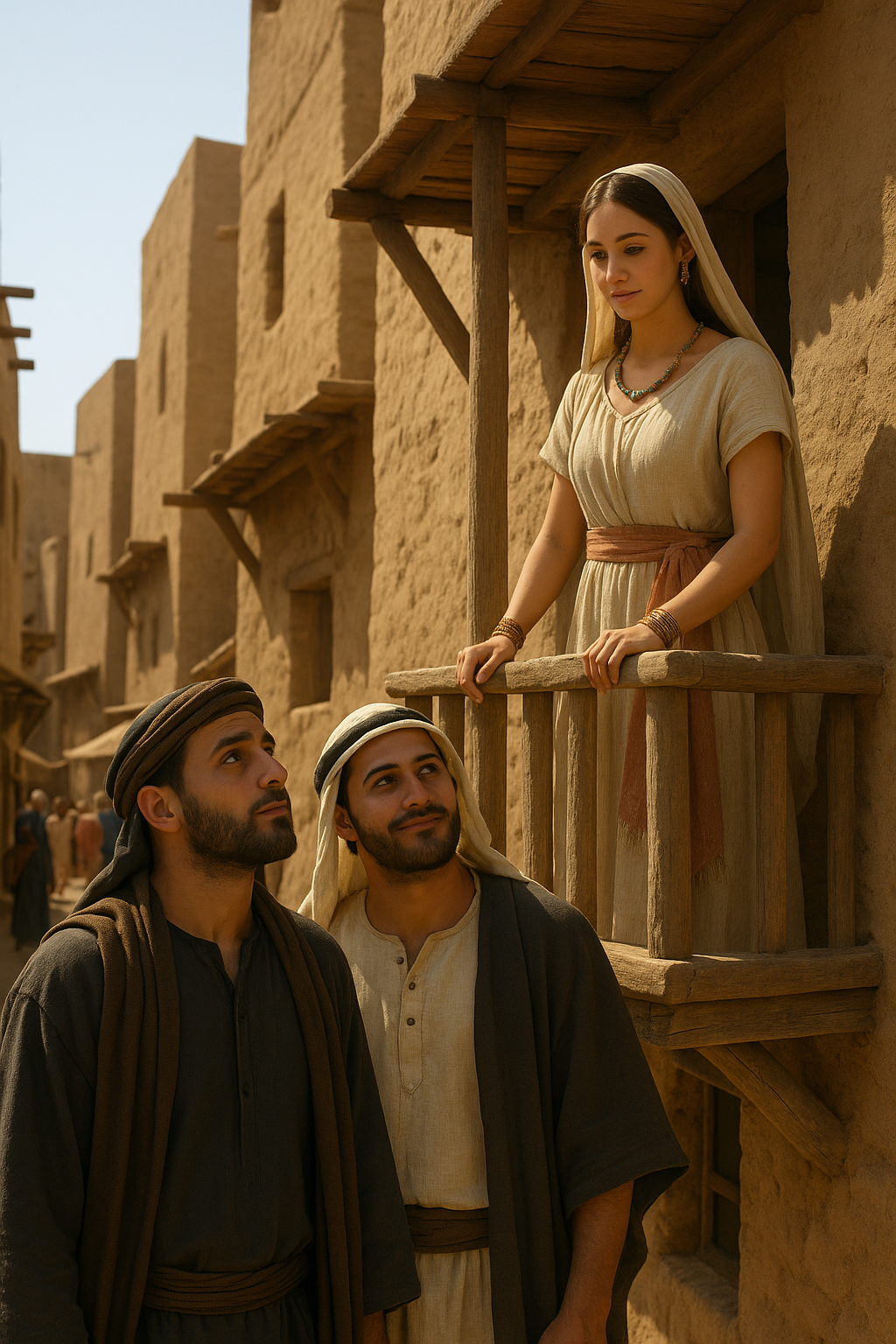
The city breathed like a beast. Jericho was not just alive—it prowled. The walls were ribs of stone and mudbrick, holding in the heat, the markets, the secrets. I had grown up in the desert where space swallowed you whole, but here the air pressed in, thick with incense, sweat, and whispers. Every alley was a vein, every shadow a trap.
Ishmael, of course, was gawking like a child. “Look at that, Raziel!” he shouted, pointing at a butcher’s stand where an ox’s head leered down, flies buzzing around its sockets.
“Only twenty shekels, my darlings,” the woman at the stall purred.
I dragged him away. “Have you forgotten we’re on a mission?”
He only grinned, ruffling my hair the way he always had since childhood. I hated it—hated how it made me feel like I was still that boy he teased under the desert sun. I fixed my braids, muttering, “God will give us the land. That’s why we’re here. Not for shopping.”
But the truth was, part of me envied him. He laughed, even in a city that could devour us whole. I remembered Joshua’s words by the fire: “The way of God is not as straightforward as you think, young Raziel.” The flames had flickered across his face, and for a moment I thought I saw God Himself smiling through him. And now here I was, paired with Ishmael—the wrong man for the right mission. Or perhaps the right fool for God’s crooked way.
We moved through Jericho’s veins, observing its muscles: the guards by the palace gate, the watchtowers looming, the marble temple in the square. Even I had to pause at its architecture: columns carved as men buckling under the weight of heaven, their stone faces frozen in eternal strain.
“Compared to our tent in the desert,” Ishmael chuckled, “this is ten times better.”
“Perhaps,” I replied, “but it’s the God in our tent that matters.”
He smirked. “Shame. We could’ve moved Him in here. Give Him some proper columns, a nice roof. Upgrade.”
“You’re insane.”
He shrugged at the massive wall girding the city. “These look impenetrable though. So, clever Raz, how do you think we’ll get through them?”
“I know nothing is impossible with God.”
“That wasn’t the question,” he sighed. “I asked how. That’s where you use the brain God gave you.”
“Why bother? He’ll do it His own way.”
“It’s called ‘conversation,’ you goat. Geez, you’re boring.”
I almost smiled. Almost. Until I noticed a boy staring at us. Too long. Too still. And then he vanished into the crowd. My stomach knotted.
Ishmael muttered, “Flip. We gotta leave.”
For once, I agreed. We slipped toward the gate, keeping our heads down. My heart pounded against my ribs like a prisoner on the inside of Jericho’s walls.
Then Ishmael stopped. His breath caught.
I followed his gaze—and the city tilted.
She was there, perched on a balcony that jutted out from the outer wall, half in shadow, half in torchlight. Rahab. She didn’t need to stand; the architecture did it for her—her house literally straddled the city’s bones, timber beams holding her between life and collapse.
Her hijab framed eyes that could gut you. Her hips curved like the city ramparts themselves, promising refuge and ruin. She called softly to passing men. The air seemed to bend toward her.
Ishmael leaned close, whispering like a man at confession: “A harlot. This must be one.”
Heat flared in my chest—not just desire, but fear. In the wilderness, sin was a story told around fire. Here it was flesh and perfume, reaching out from the city wall.
“This is a mistake,” I muttered. “What we do here could damn us. Remember the ten spies? Forty years for a bad report. What for this?”
He smirked, reckless as ever. “Half an hour, brother. What happens in Jericho stays in Jericho.”
The air pressed in, thick, complicit. My protest slipped out weak, like a whisper against stone. “Fine. Half an hour.”
I waited by her door, cloaked in shadow. The walls around me hummed with voices, the market outside thinning into dusk. Inside, muffled moans rose, a rhythm of sin echoing in timber beams. I clenched my fists. Noir isn’t about what you see—it’s about what you hear and can’t unhear.
Then the whisper of two men passing by the gate reached me: “They’re Hebrew spies. Soldiers wait outside. They won’t leave alive.”
My blood iced. The walls had betrayed us.
I shoved the door open, choking on incense. “We’ve been compromised!” I hissed. My eyes darted toward the bed—and froze.
“Gross!” I blurted, covering my face.
“Raziel!” Ishmael barked, half-naked in sweat and linen. “You idiot!”
“You idiot!” I shot back. “Soldiers at the gate! They’re coming for us!”
The woman scrambled for her wrap, fear twisting her beauty into something sharper. “Who are you?”
I swallowed. “Israelite spies. I’m Raziel. That fool is Ishmael. The God who tore the sea in half has sent us.”

Her face went pale. “Baal, strike me dead.” She paced, clutching her hair, her body moving like a trapped flame.
Ishmael stooped, hand brushing a stone in the corner, lifting it as if instinct might save him. I glared, and he dropped it with a muttered curse. Then, as if shifting tactics, he blurted out, “We’ve got money, lady! Lots of it. We’ll pay you. Just don’t tell the soldiers we’re here.”
She stared at him, shaking. “Don’t you realise hiding you makes me a traitor? They’ll kill me.”
Ishmael pressed on, his voice suddenly sharp: “That death you fear is nothing compared to what’s coming. You know our God—the One who split the sea. That’s who’s on His way.”
The room fell still, heavy with dread and incense.
Then—pounding at the door.
“Rahab!” a soldier bellowed. “Bring out the men who entered your house. They’re spies!”
The walls themselves seemed to shudder. Her eyes cut to us—black pools, bottomless. In that moment, she was more terrifying than the soldiers outside. She was the city itself: seductive, treacherous, and perhaps, our only salvation.
 Lives Between Walls
What do you think about this?