Scene 1: The Town and Its Walls
Unconventional things happened in small towns. I would know. Perhaps having such a small population density was never the gods’ ideal. I’ve found that in places where everyone knows everyone, moral boundaries blur. Wūsū, with its crumbling factories and aging lanes, was no exception. The walls here whispered as much as they watched. The town was a cage of brick and stone, and some nights, I felt like one of its lab rats. Humanity was never meant to live in isolation—yet here we are, building towers of Babel even in miniature, until our own shadows swallow us whole.
Scene 2: The House That Breathes
I am a middle-aged man, living alone in a cottage along Zhongshan Road. My family had owned this house for decades. The walls are a kaleidoscope of memory—scratches, smudges, stains that conjure moments of a life long gone. I still hear my mother scolding my younger brother through the plaster; my father’s newspaper crinkles in the timber beams; my uncle’s drunken laughter seeps through the cracks like mildew. The house breathes. Sometimes it comforts me, sometimes it mocks me, but never does it let me forget.
Scene 3: A Heart Encased in Walls
Relationships? I had my share, yes, and children too. Hua, the mother of my son and daughter, has since found happiness with someone else. I see my kids now and then—little Mingze and Mia—but the visits are irregular, and excuses flow more easily than they should. Sometimes when I look at Yui, I swear my mother’s eyes stare back at me, reminding me of everything I’ve lost. Perhaps that’s why I built these walls around my heart, brick by brick, mortar of grief and solitude.
Scene 4: First Encounter
And then you arrived, Ichika.
I first saw you one dusky evening, kneeling on my lawn with your bicycle flipped upside down, the faint glow of a streetlamp casting fractured light across your delicate hands, streaked with grease. Your clothes marked you as different—modern, urban, a university student from the city, not this provincial husk. You looked up, startled, as I called from the porch:
“Can I help you?”
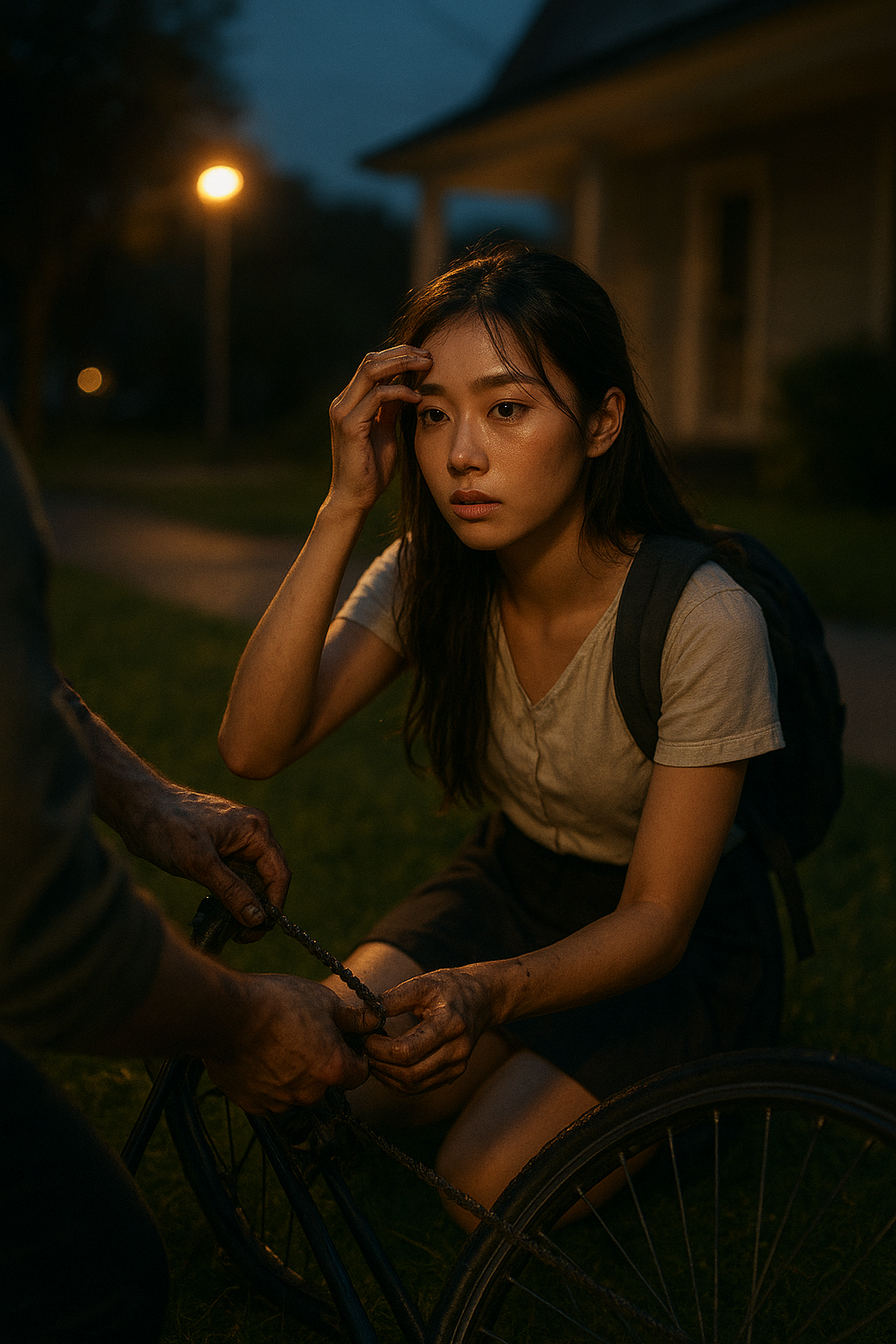
You sighed, pushing a strand of hair from your forehead, nodding as if caught off guard. “Wǒ de zìxíngchē,” you replied, pointing at the dislodged chain. The syllables clung to the night air like smoke. I crossed the yard, crouched by your bicycle, and tried to slot the chain back in place. My hands, slick with grease and nerves, fumbled under your gaze.
I could feel you watching me. Your eyes—emerald, luminous, alive—were not innocent, but curious, alert, carrying an old soul that made me uneasy. The walls around us seemed to lean closer, the porch light flickering like it, too, wanted to see what passed between us.
“Sorry, I’m a bit clumsy,” I muttered, my voice betraying more than the grease on my fingers.
“It’s okay,” you said, your tone gentle but assured. Not the voice of a child, but of a woman who knew the world well enough to steady another.
When I finally freed the chain, you straightened up, brushing your skirt, palms pressed together in thanks. “Xièxiè,” you said with sudden brightness, bowing slightly before mounting your bicycle.
I watched you cycle into the shadows, the street swallowing your figure as though the town itself had decided to keep you hidden. And yet, your smile lingered in my vision like an afterimage from a sudden flare of light.
That night, the walls of my house pressed close, amplifying my solitude. The stove crackled, the shadows shifted across the plaster, and I realized something had breached the defenses I had spent years constructing.
You had.
Scene 5: Distractions at the Factory
Needless to say, I couldn’t focus the next day at work. The factory’s wax station hissed with steam, shadows pooling under its iron machinery like restless spirits. Yet all I saw was you, Ichika—your bicycle tipped under a streetlamp, your smile lingering in my vision like the ghost of a flashbulb.
The chatter of colleagues, the daily banter, the routine that once dulled the ache of solitude—none of it carried weight anymore. You had unsettled me. Like a loose brick in a wall, a fracture in the plaster, your presence had weakened the structure I lived inside.
“What’s up with this fool today?” Marco, my workmate, slapped the back of my head playfully. But even that sting couldn’t pull me from the reverie. I burned my hand that afternoon, distracted, and the hiss of flesh against wax shot me into a cry: “Ai yā!”
“Zhēn de ma, Mingze?” my boss muttered, bewildered. The bandage they wrapped me in was clumsy, grotesque—my hand ballooned, comic if it hadn’t been so painful. I drove home awkwardly, each turn of the wheel sending arrows of fire through my arm.
Scene 6: Return at Dusk
By the time I pulled into my driveway, dusk was falling. The light slanted across the walls of my cottage, painting it half in shadow, half in glow, as if the house itself couldn’t decide whether to shield me or betray me. I stepped out, cradling my hand, when the sound of bicycle wheels cut through the stillness.
Students cycled past in a throng, their laughter echoing in the alleyways. My heart leapt—ridiculous, boyish—as though the town itself were conspiring to draw you back into my orbit.
And then, your voice again. Clear, melodic, unshaken.
“Qǐng wèn! Qǐng wèn!”
I froze. The words were harmless, polite, but they carried the pull of a siren’s call. I turned, and there you were—racing up my driveway, your bicycle discarded carelessly on the lawn, your friends whispering and giggling on the street. Shadows from the streetlamp caught in your hair, a halo tangled with darkness.
“Ni hao!” you said, stopping closer than you had the first time.
My pulse betrayed me. The walls of the cottage loomed, their windows watching, their plaster alive with judgment. Yet you didn’t flinch under their gaze. Your emerald eyes caught mine, and in them I saw something unsettling—an old wisdom buried beneath youth, a strength that pressed against me with quiet force.
“I just wanted to say thank you,” you continued, breathless, “for fixing my bicycle yesterday.”
I raised my bandaged hand, chuckling awkwardly. “Oh, nǐ de zìxíngchē? It was nothing.”
Your eyes widened at the sight of my hand. “Wǒ de tiān a! What happened?”
“Work accident,” I said simply.
Without hesitation, you reached forward, cupping my hand in both of yours. So small, yet so firm. The warmth of your palms flooded through me, silencing everything else—the street noise, the house creaks, even the reproachful hum of memory in the walls. For a moment, time stopped.
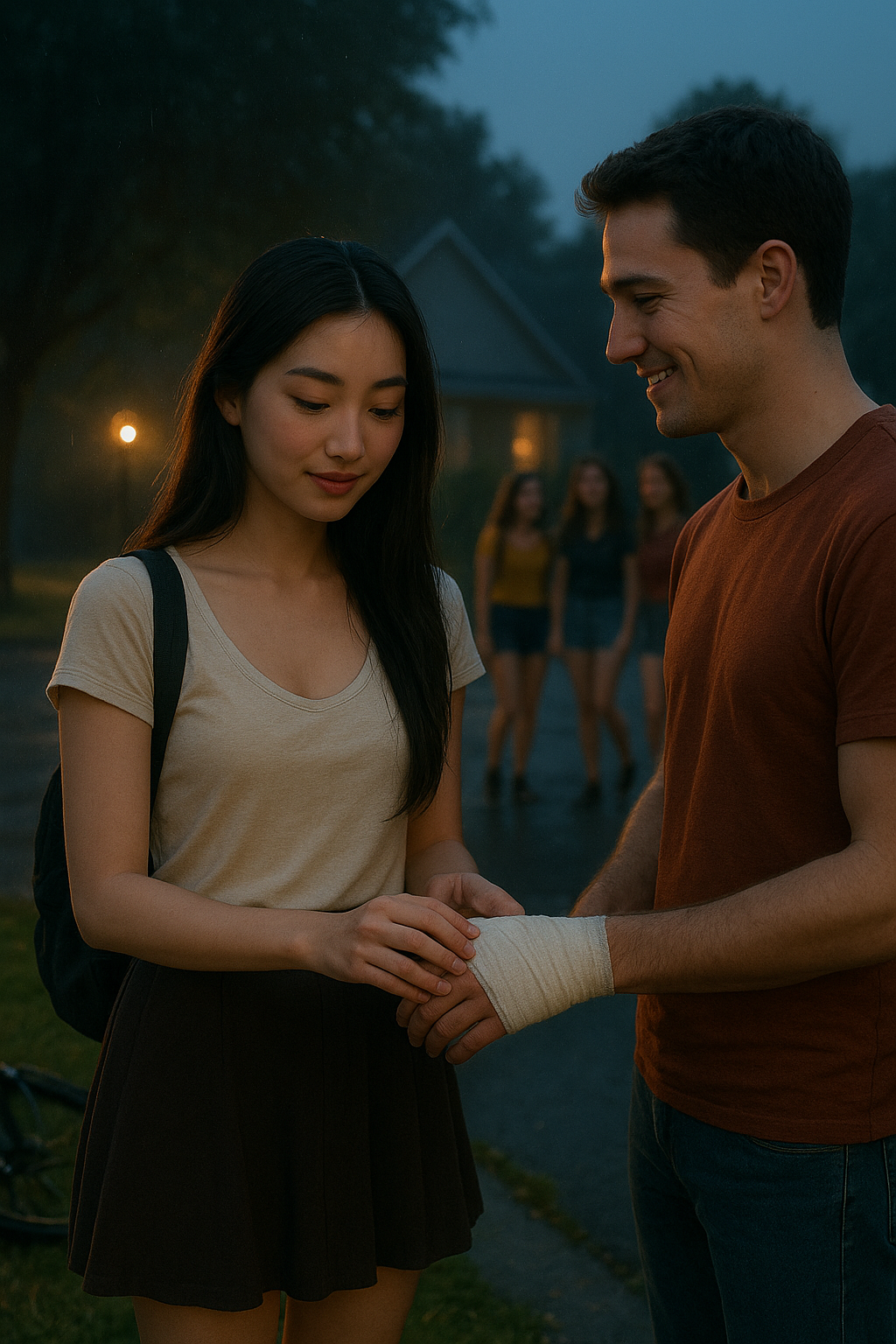
“But how?” you asked, eyes tracing the bandage with care.
I wanted to say, because my mind was on you, Ichika. But all I managed was, “Got distracted, I guess.”
You looked up then, and for a fleeting second I swore you heard the words I hadn’t spoken. The air between us grew heavy, and charged and tense. Realizing suddenly that you were still holding my hand, you instantly let go, flustered.
“Oh, sorry!”
I shook my head. “It’s okay. Really.”
Scene 7: One Song
Silence settled, thick and alive. You shifted, gaze dropping to your feet as you nudged the gravel with your shoe.
“My name is Ichika,” you said softly.
“Interesting. What does it mean?” (I knew).
“One song.”
I smiled. “Then it must be a beautiful song.”
Your cheeks flushed under the fractured glow of the streetlight. You turned away too quickly for me to see more, but the shadows betrayed you, painting your blush across the walls like an accidental fresco.
“It was nice meeting you. Zàijiàn,” you said, already stepping back.
“Zàijiàn, Ichika.”
I watched you rejoin your friends, their teasing voices echoing down the street. “Ichika yǒu nán péngyǒule!” they chanted, laughter ringing against the facades of shuttered shops and darkened windows.
The walls of my cottage seemed colder as I stepped inside. I leaned against them, pressing my forehead to their cracked surface, listening to the echoes of their silence. You had awakened something I thought buried, and now these walls, once my protectors, felt like prison bars closing in.
Scene 8: The Tug of War
That night I tossed in bed, shadows playing across the ceiling, the hum of the old stove whispering like a conspirator. I replayed the way your hands had cradled mine, the fire of your eyes meeting mine. I sighed heavily, the weight of longing pressing on my chest.
What had become of my life but a series of distractions—work, drink, memory—just to fill the spaces between fleeting encounters with you, Ichika?
The walls did not answer.
 Lives Between Walls
What do you think about this?