They said Orchidville was built on a prayer and a railway. Both were true. Rails threaded the city like a silver catechism, and prayers—spoken, swallowed, shouted into pewed air—held together a population that had arrived here from storms of history. Warren Andreev’s people had come in 1920, shaken loose from the aftershock of the Bolshevik Revolution. They disembarked with trunks, icons, and a single unbroken idea: survival through faith. In the family story, the old country burned behind them like a cathedral catching fire; ahead, Orchidville glittered with rain and the kind of hope that has a cost.
His father became a pastor; his mother kept a soft, exacting house where everything had a place—rosaries, bread, silence. If the city’s rail depots were arches and iron, then the Andreev home was a smaller chapel, floorboards taking on the gloss of candlelight, a kitchen that smelled of dill and patience. The child learned the Lord’s Prayer early, not as a speech but as a floor plan. Each line a room. Each room a rule for where to put his feelings.
They called him prodigy because he could preach before he could properly pronounce certain consonants. Eleven and already a leader; fifteen and already a rumor; eighteen and already a corridor with doors he refused to open. By the time the parish pinned a collar around his throat, the city knew his name the way the city knew the sound of trains in the rain—there, constant, comforting. He took celibacy like a vow to architecture: if bodies were unstable scaffolding, then the spirit must be the load-bearing wall.
In the long years that followed—twenty of them, precise as a ledger—Warren became the quiet inhabitant of a two-bedroom house that looked exactly like restraint. The rooms were clean, light touching surfaces in square, measured portions. A young woman named Jasmine came daily to cook and clean; her soups were too salty, her laughter steady. She’d once asked him what he did in the evenings when the house got too large. “I read,” he’d said—meaning scripture, commentaries, the old histories of saints who turned their bones into scaffolds to hold up the vault of holiness. He did not say that sometimes he listened to the train three streets away, carving night into dependable segments.
Orchidville was a city of segments: factory shift-changes and noon bells, a cathedral whose stone ribs held up years of weddings and funerals, a station whose platforms could feel like the nave of a secular church. History ran through everything like a structural reinforcement—old wars, old rounds of scarcity, the immigrants’ careful thrift. Warren wore history like a cassock. If God had an address, he assumed it was built in that same stone.
On a sky that had been rinsed to iron, the Thursday began with meetings and ended with rain threatening. The church was last to empty. Warren checked locks in a ritual sequence: narthex, side door, sacristy. Ritual had its comfort; the hands move even when the heart is tired. He stepped into cool air that smelled of wet copper. A school nearby had just released its children into the street; their voices were small explosions in a corridor of buildings, each shout ricocheting. He made for the station.
The platform was as it always was at four: a drenched marketplace of faces, a compressed parcel of the city’s lives. He entered the train the way a man enters a chapel—measured, careful, eyes lowered by habit. Standing, he took the angle of a man who expects to stand. “Father Warren,” someone said gently, and a young man with curly hair unfolded from his seat like a courtesy. “Please.”
He accepted. Habit again; the world made space for him whenever the collar was visible, like walls relocating to accommodate a priest. He sat—and paused.
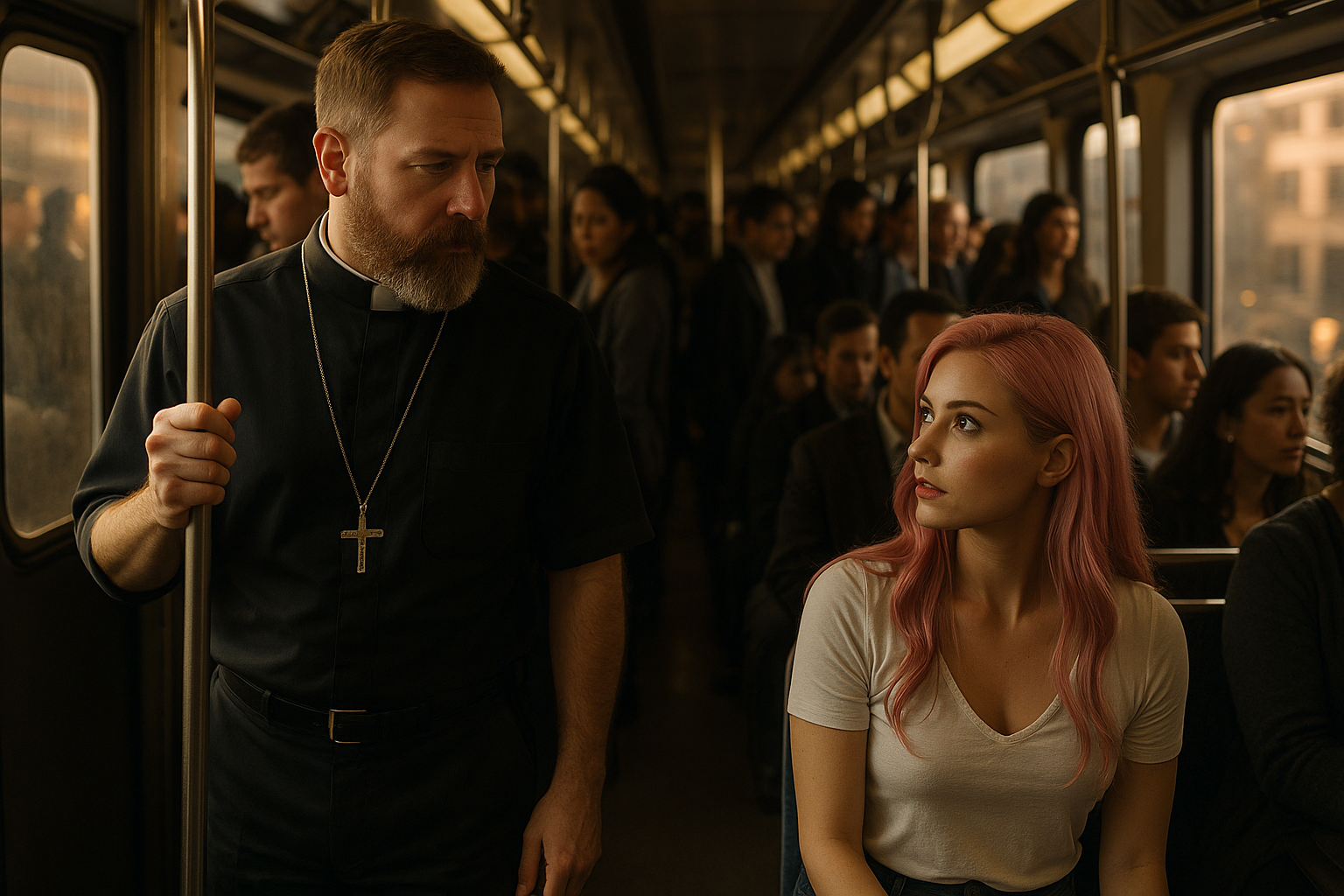
She was the first interruption in his day that felt like a crack. Pink hair, rainfall-bright, a leather skirt that turned lamplight into an invitation. Her mouth wore red like a dare, a chain glinting at her hem. He managed a warm hello, and her answer was the sound you make when at least one of your defenses stays up. Mmmh. Warren, who understood every room as a diagram of permission, looked away. His eyes, trained not to wander, wandered anyway.
Desire is not a catastrophe. It is a door. He knew this, but doors were dangerous things in houses you’ve sworn to keep locked. He muttered a short prayer the way a homeowner checks a bolt.
When the train slipped into its growl, he tried the old trick: humor to open a polite window. Humour opened doors sermons couldn’t, “This train is so slow,” he yawned softly, “I think I’ve grown a beard since the last stop.” Her laugh had warmth in it, not for him specifically but for the world’s small absurdities. A good laugh is a little renovation—something knocked down to make room for air. She took his hand when he gave his name, anchoring her tiny palm in his, and told him hers: “Ezmi.”
He tasted the syllables as one tastes a spice. Unique. In his head, he put her in a corridor labeled: Student at Orchidville University. Daughter to a Muslim father. Arabic name meaning “My Esteemed.” Each fact a tile. Each tile another line in the plan. He tried to live inside plans because open ground scared him.
It took three stops and a careless glance for his carefully hung curtains to move. He had looked down. It was involuntary: leather skirt, hem, thigh. Heat flared. She caught the look and a bright mischief lit her face. Her body didn’t move. But something did in him: a small beam shifting, a hairline crack traveling.

“What do you do?” she asked after a bit, voice sweet but angled.
“I serve God,” he said. The collar. The cross. The parish that owned his nights and kindly sent him grocery vouchers when he forgot to eat. “I teach people the ways of God.”
“So you’re celibate,” she said, amused and a bit tender, as though a door had been presented and carefully shut. “Like, by vocation.”
“I’ve chosen a higher purpose, higher than the temporal pleasures of this life,” he answered—habit again, but genuine.
“‘The temporal pleasures of life,’” she teased, gentle as rain, “Who art thou? Shakespeare?” He smiled and let the joke rinse off. “It’s not for everyone,” he said. “If God puts it in your heart, you know.”
She turned then, eyeing him with an interest that felt both kind and surgical. “Be honest,” she said, quiet, curious, dangerous in a way that didn’t involve any violence at all. “You wouldn’t want to—” Her mouth curved. She left the sentence undone and complete. The train’s light seemed to hesitate around her. He stuttered, heat rising, words failing, the collar abrupt against his throat. She laughed once, too loud, and then saw what she had done. He reprimanded her. His reprimands were part of his training: keep order in a crowded room. He felt his hands shake. She apologized, genuinely.
The train swallowed two more stations and regurgitated them as absence. Seats opened. He thought of leaving her. He thought of staying. When he began to rise, she caught his sleeve—light touch, no demand—and asked the question that would pull a wall down.
“What do you think God looks like?”
He gave the answer he had built entire rooms around: “No one has seen God. We’re made in His image. He can look like you, and me.” True enough, as far as it went. She stepped into that room and knocked on the far wall.
“So you haven’t seen him? He didn’t tell you to be this specific kind of servant?” She watched him carefully. “Is it possible your concept of God is built out of what other people told you? A plan you inherited, not a person you met?”
Warren had survived his life by knowing which questions belonged in which rooms. This one belonged nowhere. He reached instinctively for the oldest bracing beam: indignation. “What do you know of God,” he snapped, then regretted it immediately, apology arriving like a tremor.
She took it with a small smile, then made the move that changed the map. “Make sure your idea of serving God comes from God,” she said softly, “and not the building you were born in.”
He had spent two decades instructing the city. On this evening, a stranger had swung open a window and let in weather. He found himself listening the way one listens to trains at night, waiting for something large to pass.
“I’ve done this for years,” he said. “Lives changed, marriages saved, people delivered.”
“And you?”
“What about me?”
“Were you delivered?”
The interior of a person—the truth of it—is a building whose load-bearing elements you rarely examine. He looked out the window. The tracks arrowed through a strip of woods. On certain days, the trees out there looked like hands upraised; on others, like pillars marching. Patches of snow clung to the roots. Spring worked at the edges, dissolving old white into new water.
“I am happiest doing what I’m called to do,” he told her. He meant it, sort of. He meant it enough to have survived this long. He did not say what happiness had cost. The church’s ledger of him had no line item for private longing.
She sighed, brushing her pink hair back, gaze traveling the window, then returning like a tide that never learned to keep away from rock. “My concept of God?” she said. “Experience.”
He didn’t quite follow. She explained anyway, almost to herself. If God called her to preach tomorrow, she said, she would only know what died in her when she obeyed. If God called her to celibacy tomorrow, she would have to face what it meant to amputate a living desire and then pretend not to limp. “If I tried,” she said simply, “I would be lying against myself.” She shrugged. “That lie is why priests sometimes do unspeakable things. The body always finds a door.”
He flinched. “I chose this,” he said, softly stubborn. “No one forced me.”
“I believe you.” Her eyes were kind. “But did God choose it with you?” A pause. “Or did a story choose it for you?”
She studied him with a patience that wasn’t predatory. He was a man of walls; she was a woman of windows. “You learned very young that being good was the way to be loved,” she said—not accusing, not triumphant. “So you became a hero, built a cathedral, and stood in it as proof that you deserved affection. But Warren—be honest. You are not serving God if you have to disappear to do it.”
It was not a dramatic shattering. It was a hairline crack that traveled the length of him in silence, the way a sound travels the length of a tunnel long after the train has passed. He began to cry without warning. He was embarrassed—he had no practice crying in public—and then too far in to reverse. Her hand came to his shoulder, light and certain. Comfort is its own sacrament.
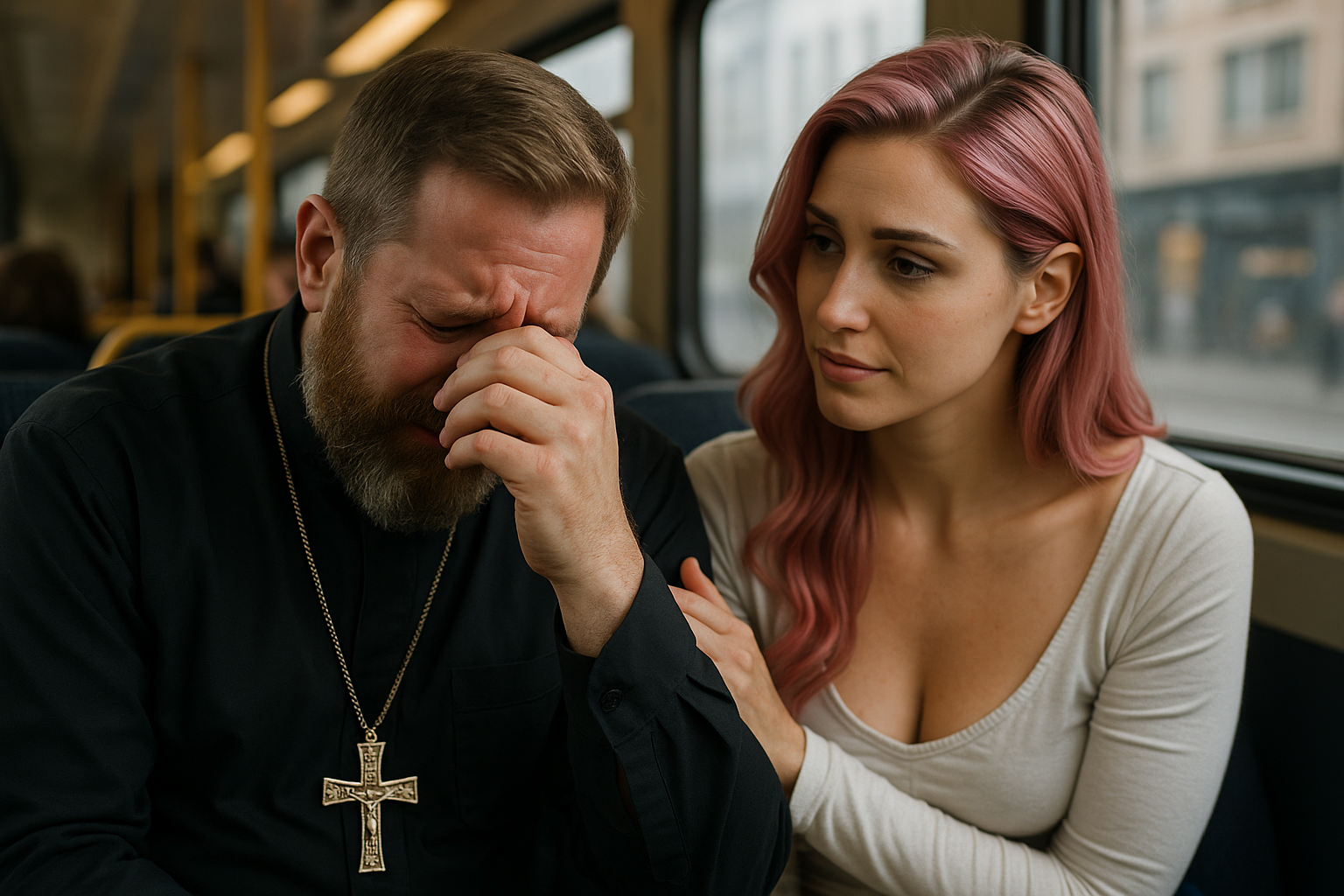
Passengers glanced, and glanced away, because a priest weeping into a girl’s touch is a complicated fresco to study at rush hour. She leaned in, her perfume a small, human warmth. Steaminess as contrast—the feeling of being a body in a place where bodies are not supposed to matter. Warren felt the shock of heat against a life that had carefully kept its thermostat low. It wasn’t lust that spilled him; it was the return of temperature. Desire’s purpose in this moment was not to seduce but to thaw. It revealed the cold.
“It’s not too late,” she murmured. “To get a new concept of God.”
Outside, the last of the snow retreated. Rain tapped the window in a patient code. Inside, something structural gave way with a sound only he could hear: the buckle of a brace, the sigh of a roof letting in first light.
When her stop approached, he thought, absurdly, that the train had a conscience and was easing its speed for him to catch up to his life. She stood, cupped his hands, and pressed a square of tissue into them, like a small white flag of surrender. “You can forget this and keep the walls you know,” she said gently. “Or you can get off this train with me and walk into weather. Let’s see what God looks like without the blueprint.”

The doors parted. Air moved. People moved. He stood there in holy indecision, feeling the rush of other lives pushing past. A man has only so many trains in him that will arrive on time. He stood. He walked.
He would later describe the next ten years as a demolition conducted with respect. He did not burn the old place down. He removed walls, one honest beam at a time. He wrote, first in secret and then publicly, about the ways doctrine can become drywall, about how the God of his childhood had been an architecture that kept out wind.
The city proved wider than his maps. He learned its alleys and its libraries, its kitchens and its back pews. He ate dessert. He laughed loud sometimes. He still prayed. When he could not find God in a plan, he found Him in a hand extended, in a rainstorm walked without umbrella, in the shock of warm skin as proof that the world had not been abandoned. He did not become reckless—history remains history—but he ceased to be the custodian of a museum and became, at last, a citizen of a living house.
By his late fifties, he had written three books. He didn’t call them theology; people did that themselves. He called them renovations. The first removed a wall between certainty and compassion. The second installed a staircase connecting justice to joy. The third knocked a skylight into a room most people kept shut. To his surprise, readers arrived with their own hammers, their own stories of houses too strict to live in. He listened. A former bishop turned witness.
Sometimes he took the train. The city always sounds different after you’ve cried in it. Once, on a day that smelled of steel and rain, he found himself watching the faces that had once been his congregation—the butcher reading a romance, a teenage boy holding a bouquet, a mother asleep on her feet, a woman with pink headphones that made him smile. He let the carriage make a chapel of itself. The rails sang beneath, and he understood: the point had never been to abandon structure; it had been to inhabit it honestly. Walls that breathe. Doors that open onto weather. A God not locked behind stone.
He would tell audiences that water gives life but drowns; that fire warms but burns. “Danger,” he said, “is what happens when we mistake a person for a blueprint.” He did not preach. He told stories about trains and kitchens and rain, and people recognized themselves: their private cathedrals, their hidden rooms, their locked cupboards full of unwept things.
The story he told in his third book didn’t end with a kiss or a scandal. It ended with a door opening. Sometimes they met for coffee in crowded places, talking about classes and courage, how to guard what was holy without turning it to stone. Sometimes they walked. He learned the language of windows slowly. When he finally touched her hand one afternoon, it felt less like sin and more like climate—the simple fact that the world has temperature.
 Lives Between Walls
What do you think about this?