I. THE DRESS
Morning arrives gently, as if the villa knows better than to rush us.
Light spills across the tiled floor, climbing the carved walls and settling into the room like a quiet decision. Saba is already awake, sitting cross-legged at the edge of the bed, chin in her palm, eyes bright with possibility.
“So,” she says, stretching. “Where to next?”
I shrug, still shaking sleep from my bones. “You choose.”
She smiles slowly. “Maybe somewhere I’m a queen. Palace. Marble halls. A town of loyal subjects who bring me fruit and tell me how wise I am.”
I glance at her. “Gee. Aimed for the stars with that one, didn’t you?”
She gasps, hand flying to her mouth, barely holding in a laugh. “Excuse you. I think it’s a very modest ambition.”
She hops up, spinning once. “Come on, Writer. Get your pen out. Do some magic.”
I squint at her. “Which pen exactly?”
She freezes. Then her eyes widen, heat rushing to her cheeks. “Wow,” she says, covering her face. “You are absolutely unbearable.”
“Effective, though.”
She swats my arm, laughing. “Hurry up before I change my mind.”
I lift the pen—and hesitate.
“Actually,” I say, “I was hoping we could go to the docks first.”
She turns, studying me now. “The docks.”
“Just briefly,” I add quickly, palms up. “Not to start anything. I just need to face something.”
She waits.
“I met him yesterday,” I continue. “The sailor. Bill. He apologised. Properly.”
“Oh,” she says, thoughtful. “That’s… unexpected.”
“Exactly. It felt too human. Like he has a life of his own.”
She smiles faintly. “An extra becoming a main character in a story you thought you controlled.”
I nod, relieved. “That.”
She exhales softly. “You don’t usually linger in places.”
“I know,” I say. But this one has gravity. Like a story that doesn’t want to end yet.
I look at her, unashamed now. “Just the docks,” I say. “Then you choose the next world.”
She studies my face, then grins. “Alright. Docks first. Then I’m ruling something.”
“Deal.”
She claps her hands once. “Fine. But if we’re going out, I need the right outfit.”
I lift the pen.
The first look appears instantly—a dramatic antique gown, heavy brocade, sleeves like sails. She stares at herself. “Am I attending court or preparing for war?”
“Royal,” I offer.
She laughs. “Try again.”
The dress melts into something sleek and vintage—soft gold, elegant, whispering rather than shouting. She tilts her head. “Beautiful… but too quiet.”
Another flick. A hipster ensemble appears—oversized jacket, scarf, boots. She squints. “I look like I argue about coffee.”
“You definitely do.”
“Unacceptable.”
The pen moves again.
She’s suddenly in the shorts that make it impossible to not notice her legs, and loose Hawaiian shirt—the one that remembers the dock too well. She stiffens.
“No,” she says immediately.
I look up. “Too much?”
She shakes her head, softer now. “That’s the outfit that drew him. I don’t want to carry that version of me back there.”
I nod. I understand.
I lift the pen again.
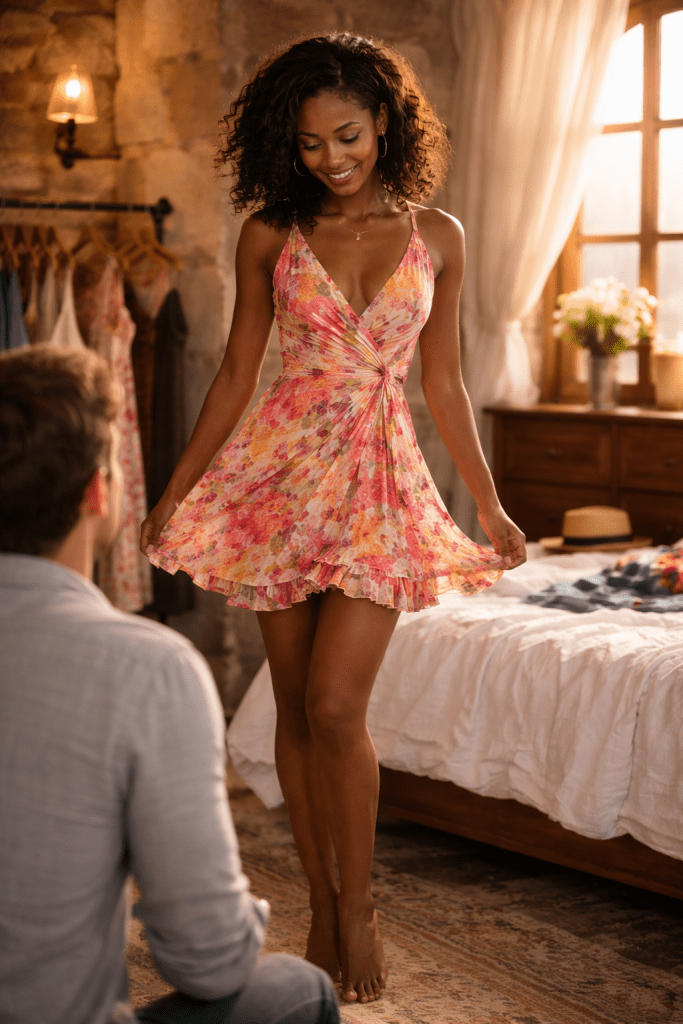
This time, a short summer dress settles over her—light, effortless, moving when she breathes. Simple. Honest. She turns once, smiling.
“This one,” she says. “This feels right.”
I smile back.
The dress settles on her like it’s trying very hard to behave.
It’s modest by design—light fabric, soft lines—but it seems to struggle with the task it’s been given. It skims where it should conceal, drapes where it should distract, the cut doing its best to downplay the truth of her shape while quietly failing. The movement of it betrays her anyway, the fabric shifting just enough with each step to hint at curves it pretends not to notice.
She turns once, assessing herself.
Dangerous, I think—more so than the shorts and Hawaiian shirt from yesterday. That outfit had announced itself. This one whispers.
She catches my stare immediately.
“Oh no,” she says, shaking her head, amused. “Looks like I’ve already attracted another sailor.”
I whistle low, mimicking the sailor from yesterday, unable to help myself.
She laughs, rolling her eyes as she grabs her bag. “Honestly,” she says, stepping past me. “You’re worse than the docks.”
We walk out together, laughter spilling into the street, the villa sighing behind us like it’s enjoyed the show just as much as I have.
II. THE DOCKS
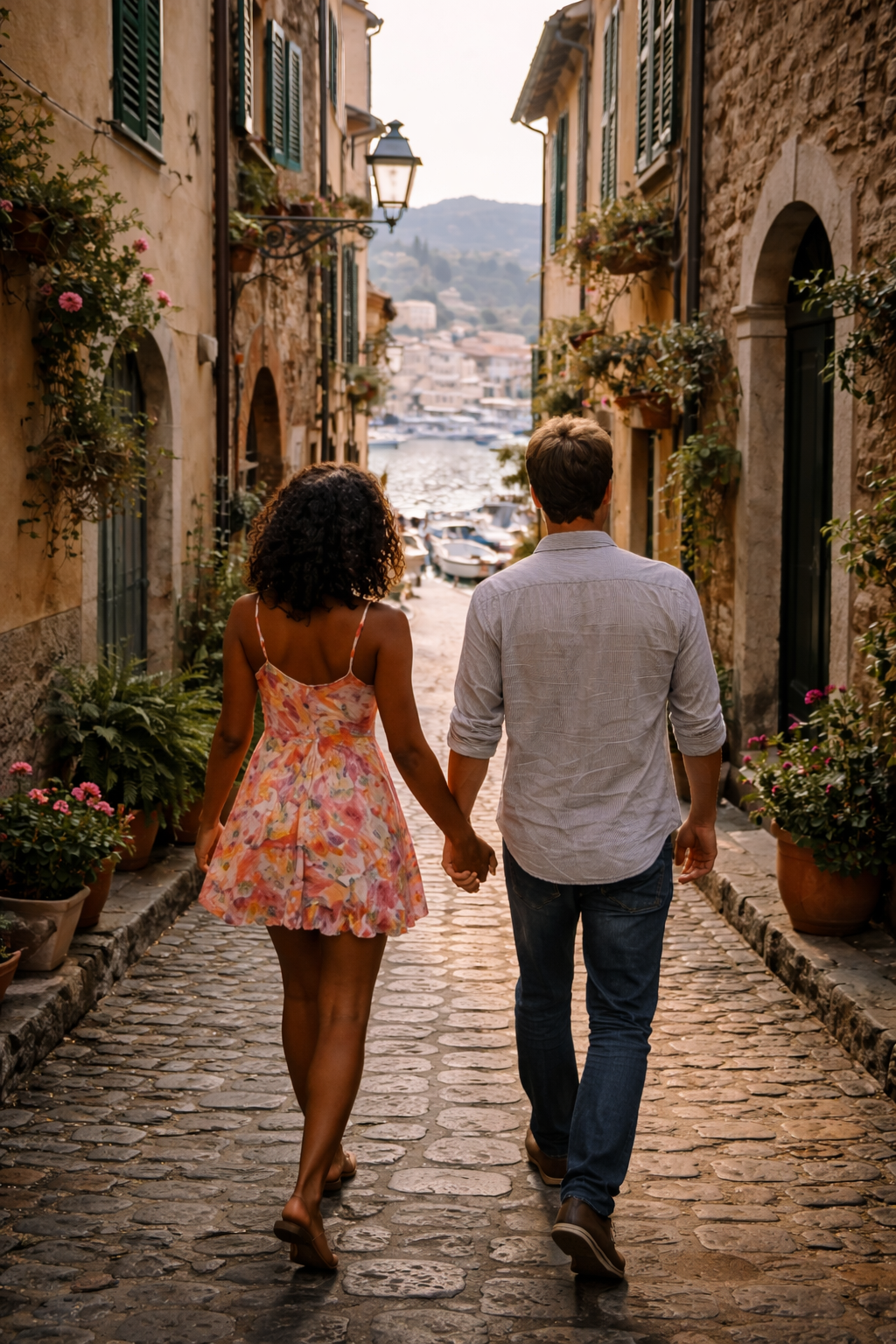
We step into the street still laughing, the sound trailing behind us like a loose thread. The cobbles warm underfoot, the morning already awake, shutters opening, cups clinking somewhere out of sight. Saba slips her arm through mine, close enough that our steps sync without effort. The dress moves when she moves, the town pretending not to notice while noticing everything.
As we walk, the architecture narrows—alleys leaning in, windows listening. The place feels intent now, not hostile, just curious. As if it wants to see whether we’ll do what we said we would.
Down at the docks, the air changes. Salt, diesel, old rope. Familiar. The boats are restless, knocking gently, like they’ve been waiting for an answer. Bill is there, bent over a coil of line, humming to himself. He looks up when we approach and stills.
“Morning,” he says, easy. Then, seeing Saba, a flicker of awareness passes his face. He straightens. “I owe you both an apology again. Yesterday—I was out of line.”
Saba meets his gaze first. Not cold. Not inviting. Just clear. She nods once. “Apology accepted,” she says, and means it. The dock seems to loosen at the sound, planks settling.
Bill turns to me. “No hard feelings, yeah?”
I consider him. The version of him I carried overnight. The one I almost made. Then the real man standing here, rope in his hands, waiting. “We’re good,” I say. And feel the truth of it land—solid, unglamorous, relieving.
He smiles, relieved too.
Saba squeezes my arm. “You did it,” she says softly.
“I think the place did,” I reply.
III. DRINKS WITH BILL
Bill invites us aboard with a tilt of his head and a half-smile, the kind that suggests hospitality without promise.
“Come on,” he says. “One drink. Boat’s steadier than it looks.”
The fishing boat smells like salt, old wood, diesel, and something faintly sweet beneath it all—fermented fruit, maybe, or time. Ropes are coiled with a care that suggests habit rather than pride. The deck bears the scuffs of work done daily and without witnesses.
Saba steps on first, light and balanced, eyes taking everything in. I follow, less certain. The water laps against the hull, patient, listening.
Bill reaches into a small cooler and pulls out a bottle, already uncapped. He pours into three mismatched cups. When he hands one to Saba, he pauses just long enough to be noticed.
“And what would a fine woman like you want?” he says, a note of performance in his voice.
Saba doesn’t flinch. She smiles—polite, distant, amused. “Surprise me,” she says. “Just don’t make a ceremony of it.”
Bill chuckles, a little deflated, and pours. “Fair enough.”
As he turns back to me, his eyes land on the pen in my hand.
He stills.
“Well now,” he says slowly. “That’s not something you see every day.”
I feel Saba’s attention sharpen beside me.
Bill gestures with his cup. “Mind if I take a look?”
I hesitate. The pen feels heavier suddenly, less like an object and more like a pulse. I glance at Saba. She gives the slightest nod—not permission, not refusal. Just choice.
I hand it over.
Bill turns it in his fingers with surprising familiarity, studying the nib, the barrel, the faint wear along its edge.
“Haven’t seen one of these in a while,” he murmurs. “Early twentieth-century design. Custom feed. Not something you buy off a shelf.”
I frown. “You know pens.”
He smiles without looking up. “I know tools.”
I take a breath. “Who are you, Bill?”
He looks at me now, really looks at me. “What do you mean who am I? You want my backstory or something?”
“You know what I mean.”
He snorts softly and hands the pen back. “Maybe you should tell me who you are. I know everyone who passes through here. Then you two show up—new faces, long legs,” he adds, flicking a glance at Saba, “and strange objects. You’re the suspicious ones.”
The boat rocks gently, punctuating the moment.
I wrap my fingers around the pen again. “I write,” I say. “And this pen… it doesn’t just record things. It makes them.”
Bill raises an eyebrow.
“Saba,” I continue, “isn’t from here. Not in the way you are. And neither am I.”
Saba shifts slightly closer to me, her voice calm but careful. “We don’t mean harm.”
Bill studies us both, then takes a long drink. “Funny thing about places like this,” he says. “They don’t always care what you mean.”
The boat creaks. The smell of salt thickens. Somewhere below deck, something shifts—cargo, memory, consequence.
“So,” Bill says lightly, as if changing the subject. “You going to tell me why you think my existence is questionable?”
I meet his gaze. “Because you feel… autonomous. More than you should.”
For a moment, the only sound is water against wood.
Then Bill laughs. Not unkindly. Not convincingly either.
“Careful,” he says. “You start questioning reality around here, you might not like what questions back.”
Saba sets her cup down untouched. “We’re just trying to understand the rules.”
Bill shrugs. “Rules change. Boats don’t.”
I can’t shake the feeling that we’ve stepped into a conversation the world has been waiting to have—with or without us.
IV. THE PERIPHERY
Bill turns the cup in his hand, watching the liquid catch the light.
“You think a story is what you write,” he says slowly. “That’s the mistake most writers make.”
Saba tilts her head. “Isn’t that… literally what it is?”
He smiles faintly. “That’s the surface.”
I don’t like how easily the word lands.
“What actually drives a story,” Bill continues, “isn’t the sentences. It’s the material underneath them. The things you never write down.”
Saba folds her arms. “Like what?”
“Memories you don’t trust,” he says. “Fears you avoid naming. Desires you half-justify. All the raw stuff that forms the shape of a thought before it becomes language.”
The boat rocks gently, as if adjusting its balance.
“That part,” he adds, “sits on the periphery. Outside the neat borders of plot and character. Most of the time, you never see it.”
I feel the pen warm slightly in my hand.
“And sometimes,” Bill goes on, “that periphery gets crowded.”
Saba’s voice tightens. “Crowded with what?”
He glances at her, then at me. “With figures that weren’t written, but were thought. With roles that weren’t assigned, but were felt. That’s where autonomy creeps in.”
“That doesn’t make sense,” she says.
Bill nods. “Good.”
I swallow. “So you’re saying you come from… the edges.”
“I come from what was necessary,” he replies. “From the scaffolding that never gets photographed.”
Saba steps closer to me. “Then what are we supposed to do with you?”
Bill chuckles quietly. “You’re not supposed to do anything with me.”
He looks at the pen again. “You’re supposed to realise you were never alone in the making.”
The harbour exhales. Somewhere below deck, something shifts—weight redistributing itself.
“So,” Saba says carefully, “some characters become… aware?”
Bill considers the word. “Aware implies intention. This is more like… persistence.”
I don’t like how closely that mirrors my own fear.
“And the spider?” I ask.
“What spider?”
“We saw a big black spider when we arrived here,” Saba blurts out.
He finally looks at the both of us fully.
“That,” he says, “isn’t a character.”
Silence stretches.
“That’s material,” he adds. “Still unprocessed.”
The boat creaks. The water laps. The periphery hums.
Bill straightens, conversation apparently done. “Finish your drinks,” he says mildly. “Tide’s turning.”
And as we do, I realise something unsettling:
Some stories don’t rebel.
They remember.
V. A VOICE ACROSS WORLDS
Suddenly, a sharp feminine voice cuts through the air, distant but unmistakable.
“You’ve been in that bloody study for hours.”
The words don’t belong to this place, and yet they do.
Bill’s mouth curves into a knowing smile. He takes another swig from the bottle and glances at me over its rim, as if he’s been expecting the interruption all along.
Saba tightens her grip on my arm, not possessive—just present. She looks at me with quiet understanding, the kind that doesn’t ask for explanations.
“Give me a second,” I call out, the words landing somewhere between worlds.
Bill chuckles and tilts his head toward Saba. “So,” he says casually, “you’re the side chick then?”
Saba turns slowly, unimpressed.
“That’s his partner in one world,” she says evenly. “I’m his partner across infinite ones.” She smiles, sharp and sweet. “You tell me—who sounds more like the side chick?”
Bill laughs, full and unbothered, raising the bottle in surrender.
I look at Saba, already feeling the pull. “I’ll see you later,” I say. “And next time—we go to your world. I promise.”
Her smile wavers, just slightly. She nods anyway, brave in the way only someone who understands impermanence can be.
“Don’t be long,” she says softly.
I nod to Bill. He answers with a lazy salute.
When I lift the pen, the world responds at last.
The docks begin to fold, wood creasing like paper, water flattening into ink. The air thins. Saba leans her head against my shoulder, familiar and warm. I wrap an arm around her, my hand resting at her hip, holding the shape of her for as long as I’m allowed.
The notebook closes.
And she disappears into it.
The study returns around me—desk, lamp, dust caught mid-light. My wife stands at the doorway, arms folded, impatience softening into concern.
I look down at the closed notebook in my hands.
It’s heavier now.
Not with escape.
With responsibility.
 Lives Between Walls
What do you think about this?