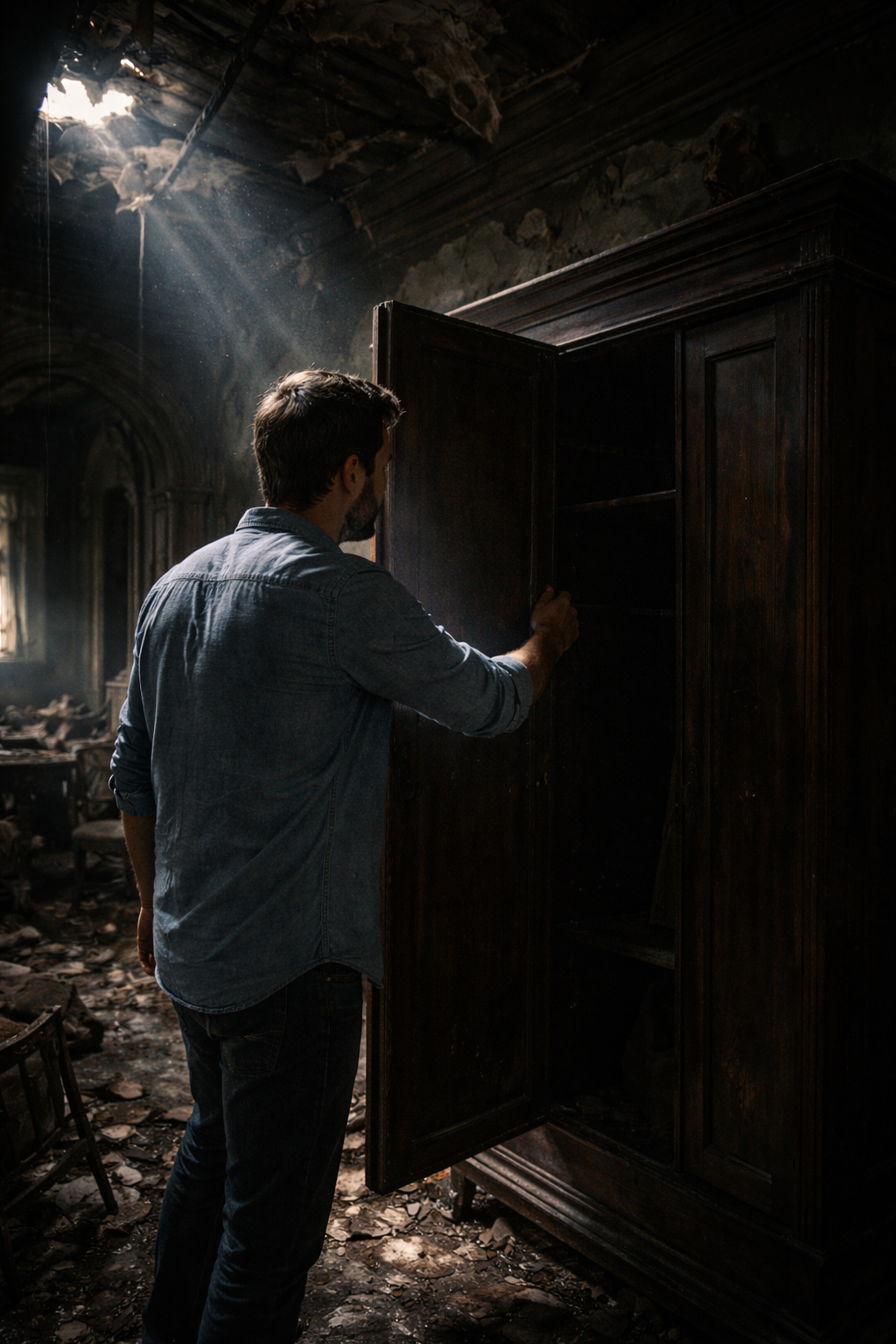
The spider is close now.
Close enough that the air changes.
It smells wrong—wet earth and rot, something ancient and sour, like a cellar that’s never known light. The forest presses in, branches bowing inward, the canopy knitting itself shut above me. My chest tightens. The air thins. The world narrows.
My hands are slick with sweat. My legs won’t listen.
Every instinct screams run.
I turn—
Saba is gone.
No ripple in the water. No retreating footsteps. No farewell.
Just absence.
The truth hits harder than the fear.
Alone.
The trees lean closer, their weight bending the dark around me. Before I feel the spider, I feel the cupboard—wood pressing against my knees, the air stale and used up, the smell of dust and old coats. My lungs seize.
I start to shake.
“Daddy,” I whisper, voice breaking. “Please come get me. There’s a spider in the closet.”
The forest dissolves.
I am small again.
Darkness presses against my face. My fists pound the cupboard door, over and over, until my arms ache and my throat burns raw.
“Help!”
“There’s a spider!”
“Please!”
My lungs scream. My body curls inward, trying to disappear from itself.
I shout for my wife.
She’s there—on the other side of the bed. Awake. Smiling at something glowing in her hand. She doesn’t look up. Her laughter lands soft and distant, like it belongs to another life.
My father stands nearby.
He watches.
Smiles.
“Abandonment,” he says calmly.
The word echoes, multiplying, filling the space where comfort should have been.
I collapse.
Knees hit the ground hard. Hands clutch my head as if I can hold my thoughts inside my skull. I rock there beneath the spider’s shadow, sobbing—not from fear of the creature, but from the ache of being unseen.
Unchosen.
Uncollected.
Then—
The cupboard opens.
Light explodes in.
It’s blinding, sudden, disruptive—tearing through the darkness that had started to feel permanent.
Someone steps in.
It’s me.
Older. Steadier. Breathing.
I kneel in front of the boy, gentle, unafraid. I reach past him and lift the spider from his back as if it weighs nothing at all. And is suddenly very small.
“Here,” I say softly. “I’ve got it.”
The boy looks at me, eyes wide, trembling.
“You’re not alone,” I tell him, smiling—warm, certain. “I’m always here with you.”
Something in him loosens.
Something in me does too.
For a moment—maybe longer—I can’t tell where I am anymore. Everything feels real. Too real. Like the truth has no single address.
When I open my eyes, I’m back on the balcony.
Stars hang overhead, indifferent and steady. The journal rests in my hand. The pen is warm, as if it’s been working without pause. Cold air brushes my skin, sharp enough to wake me fully.
I must have fallen asleep.
And yet—my heart is still racing.
Adrenaline hums through me, a quiet witness to something that refuses to be dismissed as a dream. My breath takes time to slow. The night offers no applause, no sign of victory.
The house watches me blankly as I rise.
Inside, the bedroom waits.
My wife lies there, just as before.
I slip into the bed beside her.
It feels different tonight.
Warmer.
Not fixed. Not healed.
But less empty.
I lie there, staring into the dark, aware of a truth that doesn’t need permission anymore:
As long as I am with myself,
I am not abandoned.
Not anymore.
The next morning arrives without ceremony.
Laundry waits. Breakfast dishes stack themselves without asking. School shoes lie abandoned in the passage, one upright, one on its side. The ordinary weight of living resumes, indifferent to revelations.
I move through it anyway.
I packs lunches. Tie shoelaces. Wipe spills without comment. When I speak to my wife, my voice is gentle—careful without being eager. She responds distractedly, already halfway elsewhere, her tone hollow, distant.
Once, that would have lodged in me. Today, it doesn’t.
There is no tightening in my chest. No inward plea to be seen.
I let it pass.
Later, I’m on the floor with my daughter, building something that refuses to stand upright. She laughs when it collapses. I laugh too—fully, without checking myself. I let her climb onto my back, carry her down the passage like a horse, listening to the way joy comes so easily to children before it’s taught to shrink.
I watch her closely.
How quickly a careless word could become a memory.
How easily silence could become a shadow.
I resolve—quietly, without vows—that she will never learn fear from my absence.
In the afternoon, I cook. The kitchen fills with heat and sound—oil crackling, a pot humming low. I move with an ease that surprises me, humming without noticing.
Then, clear as breath beside my ear:
“I’m proud of you.”
I freeze.
There is no confusion this time. No question.
It’s her voice. Saba. Distinct. Certain.
My chest tightens, and the tears come without warning—hot, sudden, unstoppable.
“Daddy?”
I turn. My daughter is watching me, head tilted, concern knitted across her small face.
“Are you okay?”
I wipe my eyes quickly, kneels to her level, smiles—a real one.
“Yeah,” I say softly. “I’m okay. Sometimes grown-ups cry when they’re happy.”
She considers this, then nods, satisfied. “Okay.”
That evening, we sit together on the couch, plates balanced carefully, television murmuring in the background. The same shows. The same furniture. The same life.
Nothing has changed.
And yet—
I am here.
Not reaching. Not withdrawing. Not waiting to be rescued.
Just present.
And I understand now—finally—that sometimes, when everything inside has shifted, that is enough.
Later that evening, I go out for a drink.
The bar hums with the familiar noise of old friendships—glasses clinking, music losing the fight to conversation. We crowd around a table, shoulders loose now, the week finally behind us.
Someone starts rehashing the weekend.
“I spent two days fixing a leak,” one of them says. “Made it worse. Classic.”
Another groans. “Kids’ birthday party. I’m still finding glitter in places glitter should not exist.”
Laughter rolls easily.
Then the attention turns to me.
“So,” someone asks, “what did you get up to?”
Before I can answer, another friend smirks. “Let me guess—you locked yourself in the study all weekend. Hiding from that darling wife of yours?”
The table explodes.
I laugh too. Not defensively this time. Not bitterly. Just… amused.
And in that laugh, she flickers through me—Saba’s smile, the way she held my gaze without flinching, the warmth of her hands. The balcony. The rain. The forest. The way the world had felt briefly sacred, as if it had bent around us to listen.
I lift my glass.
“Actually,” I say, smiling to myself, “I had the adventure of a lifetime. With the woman of my dreams.”
There’s a pause.
“Aww,” one of my lady friends says, grinning. “That’s actually really sweet.”
The conversation moves on, already reaching for the next story, the next laugh.
But somewhere—across time, across worlds—I feel it.
Saba smiling at me.
And the warmth settles in my chest, quiet and certain, like something that doesn’t need proof to be real.
 Lives Between Walls
What do you think about this?