It was a normal day when the realisation came—quiet. It didn’t announce itself with trumpets or ruckus.
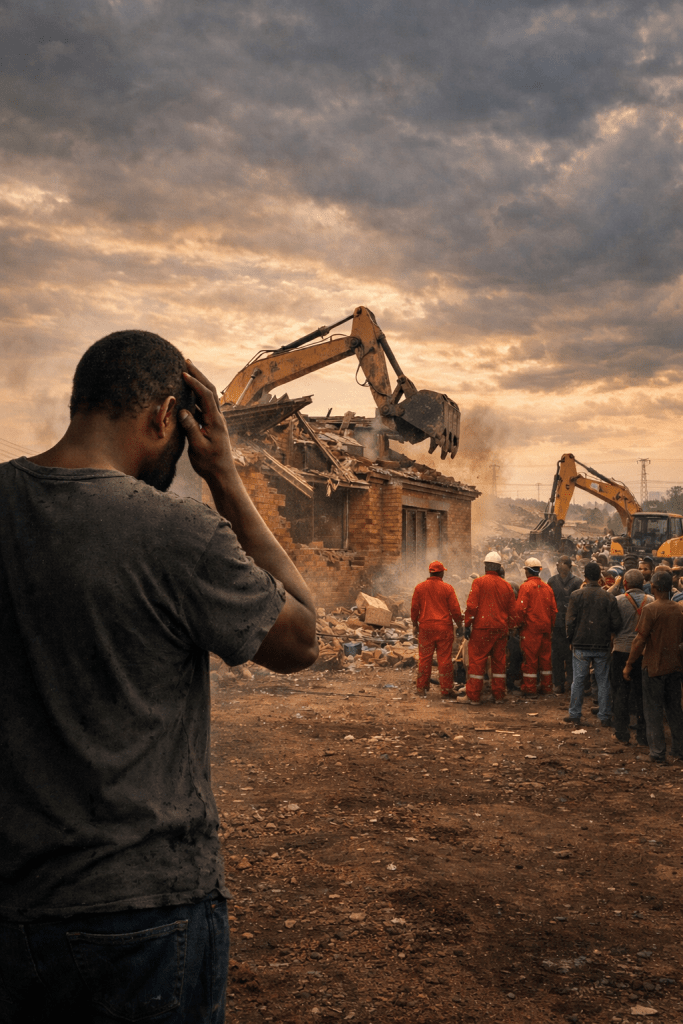
I simply saw the excavators pull up outside our house.
“Daddy, what is going on?”
A question asked with so much trust. So innocent.
And I knew—only I knew—that this house had been built illegally.
They gathered outside my home: the machinery, the men dressed in red. Demons from hell, given permission by the god of the city to raze what I had built.
What I had been building for years.
What I had poured sweat into.
What I had prayed over when nobody was watching. Now it was going to be brought into oblivion.
I watched from the window as a crowd gathered.
Neighbours. Feigned concern. In their hearts, secretly thankful it wasn’t their house.
I pulled back the curtain and sat on the couch, suddenly too tired to stand.
The house looked back at me like something that already knew the truth. I couldn’t lie to it. The lie was already in its foundation.
I remember the day I was warned.
Someone told me the site I wanted to build on had not been approved.
But I was too proud to listen. Too proud to pause. Too proud to reason.
I just wanted a house so I could be deemed successful.
So I could be seen. So I could finally feel like I had arrived.
But at what cost?
The god of the city never forgets.
And today he has come to reckon my account.
I held my son tightly in my arms.
I failed him.
I failed to build him a lasting legacy because of my obstinance.
And now he was going to lose it too—because of me.
People outside think I was just unlucky. They say the god of the city is ruthless for demolishing the house of a good man like me.
They don’t know a warning was given—and I didn’t listen.
Mercy doesn’t live where warnings are ignored.
Jonah.
I kissed my son. The calls of the men outside grew louder.
“Come out. This is your final warning.”
I let my son Jonah run out first—to a relative—so I could have a moment with the house.
One last moment.
I ran my hand along its walls, along passages that seemed to tighten like a throat withholding tears.
“I’m sorry,” I whispered.
The echo reverberated through the now-cold rooms.
The captain of a boat must sink with the ship.
People who used to be close to me have abandoned me.
My neighbours stood at a distance, ready to step aside like spectators moving out the way of a massive tree about to fall.
I was alone.
The loneliest I’ve ever been. And I wanted to die with this house. Die with my poor decision. Die with my pride.
“Final warning!”
Outside, the excavator growled—hungry for carnage.
“I will die here.”
The machines roared.
Then the sound—violent, final—of something structural giving in. A loud crack.
A loud thud.
Rafters breaking through ceiling board, collapsing toward me like the sky itself was tired of holding up my lies.
A tile struck my head.
Everything went dark.
Next thing, I am in the sea—engulfed by water.
I am sinking. Running out of breath. This is just, I tell myself. This is fair.
But then—suddenly—I am swallowed by something that feels like a fish.
A living chamber.
A warm prison.
I gasp, shocked that I am alive.
Shocked that I can breathe.
I am grateful, and yet I want to die at the same time, because what life do I have after this?
I have been stripped of all dignity.
All significance.
All story.
They pulled me out of the house just in time.
Before it collapsed fully.
I sat there in the dust among the people, watching my home being crushed and brought to the ground.
Watching years become rubble.
Watching my name become a cautionary tale.
And then I was numbered among the homeless.
Among those who had to start again.
I lost my title as someone successful. And my right to be admired.
From that day, I kept company with the outcasts of society—the divorced, the homeless, the underdogs.
And became their light.
And the god of the city watched.


 Lives Between Walls
Leave a Reply to Simphiwe Cancel reply