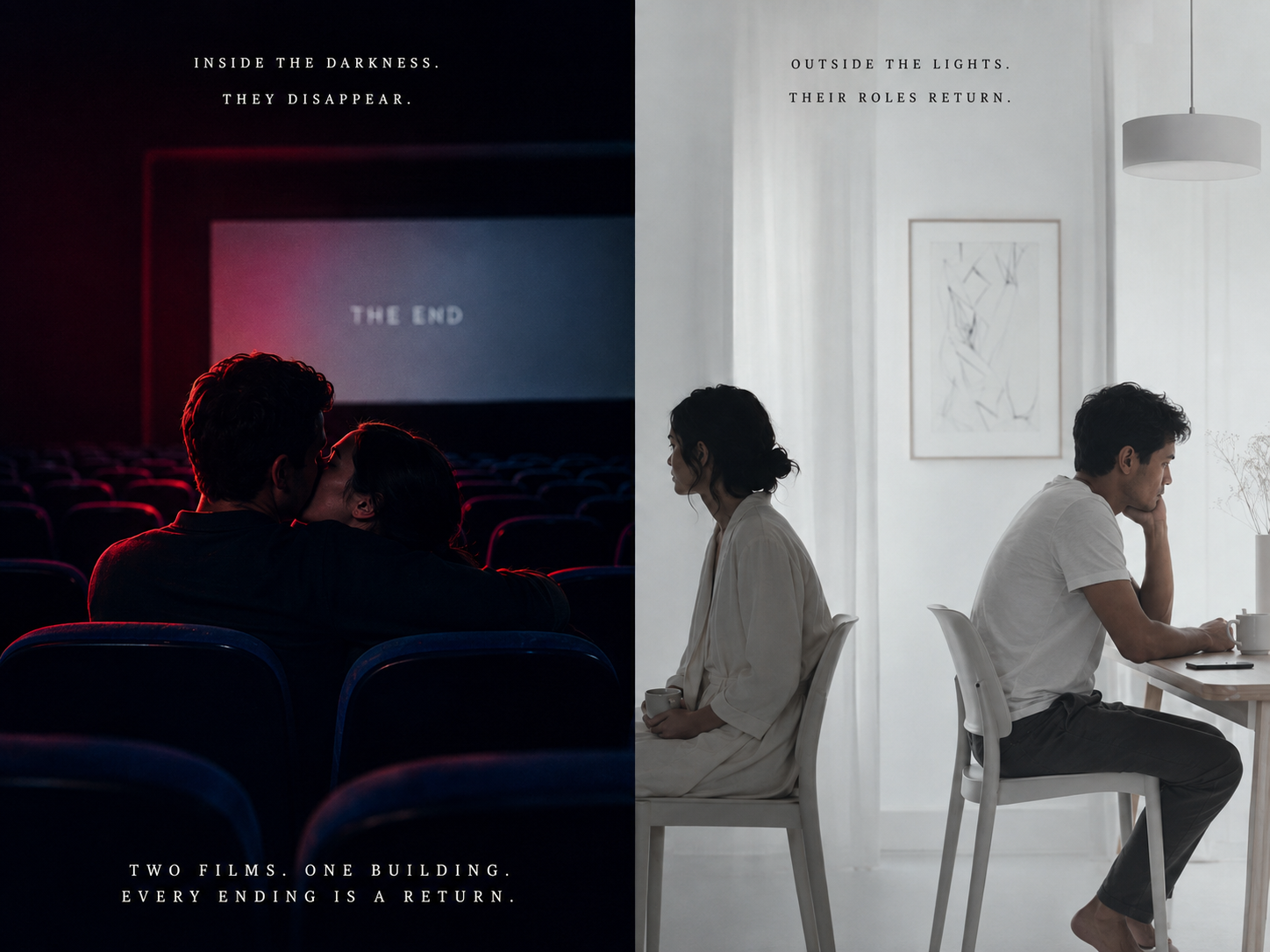
The first movie was an accident.
Neither of them remembered its name afterwards.
They had been friends long enough for friendship to have become harmless. That was the word they used for it. Harmless. They could have coffee together because coffee was harmless. They could have lunch because lunch happened beneath fluorescent lights and among waiters and invoices and people typing on laptops. They could complain about work. They could complain, carefully, about home.
They could laugh.
There was nothing illegal about laughter.
The movie came after lunch.
“We could watch something.”
She looked at the time.
“Now?”
“Why not?”
There were several reasons why not. Neither mentioned them.
They bought their own tickets.
The cinema building accepted this arrangement without comment.
It stood at the end of the shopping centre corridor, beyond the restaurants and clothing stores, behind a wall covered with enormous faces of people whose problems could be resolved in one hundred and twenty minutes. The foyer was bright enough. There were children carrying popcorn. Couples taking photographs. A man arguing about a ticket.
Nothing suspicious lived there.
Not yet.
They entered Auditorium Six separately enough to satisfy themselves and together enough to know they were lying.
The room was almost empty.
The cinema had already begun its work.
First it took away the shopping centre.
It closed its behind them and the noise of trolleys, tills and conversations disappeared. Then it took away the afternoon. There were no windows inside Auditorium Six, no weather, no Johannesburg sun, no indication that somewhere beyond those walls cars were moving through intersections and husbands and wives were sending messages asking what time people would be home.
Then it took their faces.
The lights dimmed.
They sat beside each other.
There was an armrest between them—the last boundary between two worlds.
For the first twenty minutes, they watched the movie.
Or pretended to.
Her elbow touched his.
Neither moved.
On the screen, somebody was running from an explosion. Somewhere behind them, somebody opened a packet of sweets. The plastic crackled obscenely loudly in the dark—like an accusation.
Her knee touched his.
This time she moved.
Then, several minutes later, moved back.
The cinema noticed.
It lowered the lights further.
It raised the sound.
It made conversation impossible and silence intimate.
Even the armrest seemed to scoot away at the building’s instruction.
Their shoulders rested against each other now. It seemed less like a decision than a consequence of the seats. The chairs were too close. The room was too dark. The screen was too bright to look anywhere else.
So when she turned to whisper something about the movie, he turned too.
Neither remembered what she had intended to say.
Their faces were suddenly there.
Close.
Closer than friendship had any business being.
The cinema held its breath.
Their lips touched.
Once.
They pulled apart immediately.
The people on the screen continued talking as though nothing had happened.
She stared forward.
He stared forward.
Neither absorbed another second of the film.
A few minutes later, their hands found each other beneath the armrest.
Then she turned again.
This kiss lasted longer.
The cinema swallowed it whole.
***
When the credits rolled, the building returned their lives.
First the lights.
Then their faces.
Then the aisle.
Then the door.
By the time they reached the foyer, they were two friends again.
She adjusted her handbag unnecessarily.
He checked his phone.
“Okay,” she said.
“Okay.”
“Thanks for the movie.”
“Yeah. It was good.”
It had been terrible.
“Drive safe.”
“You too.”
They walked in different directions.
The cinema pursed its lips, seemingly amused at all the things they had left unsaid.
Whatever had happened inside Auditorium Six had ended with the movie.
***
They did not speak for seven days.
This was more difficult than either expected because the cinema had apparently followed them into their phones.
COMING THIS FRIDAY.
BOOK NOW.
DON’T MISS THE MOVIE EVERYONE IS TALKING ABOUT.
She dismissed the notifications.
He scrolled past the advertisements.
A trailer appeared between two videos.
He watched it.
Not because the movie interested him.
Because he recognised the seats.
The darkness.
The little lights along the floor.
The corridor leading towards the auditoriums.
He remembered her face illuminated blue by the screen.
He closed the app.
Two days later, the cinema found him somewhere else.
NEW RELEASES THIS WEEK.
It found her too.
The algorithms knew nothing about adultery. They knew only that two customers had purchased tickets on the same afternoon and that customers who watched one movie might want to watch another.
The machines were innocent.
The building however was not.
On the eighth day, he sent her a message.
There’s another movie showing.
Three dots appeared almost immediately.
Disappeared.
Returned.
I saw it.
He smiled.
Want to go?
This time there was no delay.
Yes.
Then, perhaps frightened by the speed of her own answer:
Could be fun.
***
The second time, they chose the back row.
They did not discuss the first kiss.
That would have made it real.
Instead they bought popcorn.
They debated whether the sequel would be better than the original.
They laughed in the foyer.
They were friends.
Auditorium Three took care of the rest.
The doors closed.
The lights dimmed.
The architecture removed the world.
This time they lasted eleven minutes.
Afterwards, neither could explain the plot.
***
For nearly a month afterwards, she refused to see him.
Guilt made her industrious.
She went home earlier. Cooked more often. Asked her husband about his day and listened carefully to answers that reminded her why she had stopped asking. She tried to resurrect conversations that had died years before.
She tried tenderness.
She tried silence.
She tried obedience.
The house received each attempt and returned it unchanged.
Unlike the cinema, her house had windows.
Too many of them.
Morning entered whether invited or not. Bills lay on counters. Laundry accumulated. Doors slammed. Words remained in rooms long after they had been spoken.
There were no credits.
Nothing ended after two hours.
Home remembered everything.
Weeks passed.
Then one Thursday afternoon she sent him a poster.
He stared at it.
The film looked dreadful.
The title was dreadful.
The actors looked embarrassed to be on the poster.
Reviews had already begun appearing online.
One star.
Two stars.
One reviewer had called it “an exhausting waste of an interesting premise.”
He typed:
This looks terrible.
She replied:
I know.
He stared at those two words for a long time.
Then understood.
***
This time, however, the outside got in.
They were walking through the foyer when someone called his name.
He froze.
She continued walking for half a step before stopping.
A man approached them smiling.
“Hey! What are you doing here?”
His mind produced no answer.
The man looked at her.
Then at him.
“Where’s your wife?”
There it was.
The outside world had entered the cinema.
“No, no,” he said quickly. “We’re just friends. Came to watch a movie.”
“Ah.”
The man smiled, but differently now.
Or perhaps he imagined it.
“Okay.”
They laughed.
Too loudly.
There was a brief conversation about work, families, traffic. Normal things. Useful things. Things people said beneath bright lights.
Then they excused themselves.
Inside the auditorium, she whispered:
“We can’t arrive together anymore.”
He nodded.
“We can’t leave together either.”
“No.”
A pause.
“I’ll come first.”
“And I’ll book somewhere else.”
“Not next to me.”
“No.”
“When the movie starts—”
“I’ll move.”
She looked at him.
The screen illuminated half her face.
They had become good at this.
That frightened her.
She kissed him anyway.
***
After that, the quality of the films they chose deteriorated dramatically.
They became connoisseurs of failure.
They studied ratings.
Read reviews.
Avoided opening weekends.
A movie described as “the year’s most anticipated release” was useless to them.
A movie described as “a breathtaking cinematic achievement” was dangerous.
But a film with twelve percent on Rotten Tomatoes?
Perfect.
A badly dubbed thriller released three weeks earlier?
Promising.
A romantic comedy whose trailer had seventeen thousand dislikes?
They booked immediately.
They learned which auditoriums emptied fastest.
They learned Tuesday afternoons.
Late Sunday screenings.
The final week before a film disappeared from circulation.
She always arrived first.
She bought one ticket.
One drink.
Sometimes popcorn.
She entered alone.
He came fifteen or twenty minutes later.
One ticket.
No popcorn.
They booked seats far apart.
C4.
H11.
F2.
Respectable distances.
Distances that could survive an investigation.
Then the trailers began.
The doors closed.
The lights dimmed.
He moved.
The first few times his footsteps terrified them.
He would climb the dark stairs while she stared stubbornly at the screen, pretending not to know the man approaching her row.
Then he would sit beside her.
For two hours they belonged to Auditorium Four.
Or Seven.
Or Two.
Never to each other outside it.
That was the agreement.
They did not have dinner afterwards.
They did not hold hands in the parking lot.
They did not send goodnight messages.
They did not discuss futures.
The cinema demanded none.
Inside, she rested her head against him.
He kissed her forehead.
Sometimes they kissed until they forgot there was a screen in front of them.
Sometimes they did nothing at all.
They simply sat close.
The cinema wrapped darkness around them.
It asked no questions.
It had been designed to suspend disbelief.
That was, after all, its function.
Outside, a married woman and a married man could not belong to each other.
Inside, they were merely two characters whose circumstances had not yet been explained.
Eventually they stopped pretending to care what was showing.
The worse the movie, the better.
Empty seats became luxury.
Bad dialogue became privacy.
Box-office failure became architecture.
They would laugh quietly when another patron stood halfway through a terrible film and walked out.
One less witness.
One more row belonging to them.
The cinema seemed pleased.
It shut the door behind the departing customer.
Darkened itself.
Raised the volume.
Protected its favourite story.
Its favourite movie.
Because there were always two films showing in those auditoriums.
One on the screen.
And one in the back row.
The first had actors, scripts, producers and a rating.
The second had no title.
No tickets had been sold for it.
Nobody knew it existed, except the cinema.
A movie that it had itself directed for the purpose of its own amusement.
Perhaps one of many.
And every time the credits began to roll, both films ended together.
He would return to his original seat.
She would straighten her clothes and collect her handbag.
They waited.
The lights rose slowly.
Their faces returned.
Their marriages returned.
Their names returned.
Sometimes she looked at him across the empty rows as though she wanted to say something that could survive the lights.
She never did.
The cinema would not allow it.
It had given them a rule from the beginning:
Nothing that happened inside could leave.
So she walked out first.
He waited.
Five minutes later, he followed.
By then Auditorium Six was empty.
A cleaner entered carrying a black refuse bag.
He swept popcorn from beneath the seats, collected two empty cups and lifted a sweet wrapper from the back row.
On the screen, the final credit disappeared.
The projector went black.
The room forgot them.
Outside, she was already driving home.
He was walking towards another exit.
And above the entrance to the cinema, a digital poster quietly changed.
A new movie was coming Friday.
Bait.
 Lives Between Walls
What do you think about this?